
Types of Iron Infusions in Houston
👋 Welcome to Your Cellular Reset:
If you are researching iron infusions, you are likely intimately familiar with the exhaustion that comes from severe iron deficiency anemia. It is a profound, cellular fatigue that sleep cannot fix. Perhaps you have spent months battling the severe gastrointestinal side effects of oral iron supplements—nausea, cramping, and constipation—only to have your lab results show that your Ferritin levels have barely moved. When your gut refuses to absorb iron, delivering this essential mineral directly into your bloodstream is not just an alternative; it is the medical gold standard. However, the world of intravenous therapy is complex. You will hear names like Venofer, Injectafer, and Feraheme. Understanding the differences between these formulations is the first step toward regaining your energy and your life.
At Revived Personalized Wellness, led by Dr. Trevor Peck, MD, we recognize that no two patients have the exact same metabolic needs. The type of iron your body requires depends heavily on the severity of your anemia, your kidney function, your medical history, and how rapidly your body needs to replenish its oxygen-carrying capacity. In this comprehensive clinical guide, we will explore the five primary types of iron infusions, how they function on a cellular level, and what makes each one suitable for specific health profiles. As always, consult your doctor before starting any new therapy, including iron infusions, to ensure it is appropriate for your specific condition, in alignment with guidelines from the National Institutes of Health.
Why Are Iron Infusions Medically Necessary?
For a healthy individual, dietary iron is absorbed through the gastrointestinal tract. However, for millions of people, this pathway is compromised. Iron infusions are typically recommended when oral iron supplements prove entirely ineffective or cannot be tolerated due to severe gastrointestinal distress. The stomach and intestines act as a highly restrictive gatekeeper for iron; if you suffer from conditions like irritable bowel syndrome (IBS), celiac disease, or have undergone gastric bypass surgery, your body may physically reject or fail to absorb oral iron.
Furthermore, infusions are an absolute clinical necessity when there is a critical need for rapid replenishment of iron stores. As noted by the Mayo Clinic, situations such as preparation for major surgery, postpartum hemorrhage, or chronic conditions that cause ongoing internal blood loss require immediate intervention. By bypassing the digestive system entirely, an IV infusion guarantees 100% bioavailability. Your body receives the exact raw materials it needs immediately, allowing your bone marrow to start producing healthy, oxygen-rich red blood cells without delay.
The 5 Primary Types of Iron Infusions
Various formulations of intravenous iron are available today. They differ primarily in the “carbohydrate shell” that surrounds the core iron molecule. This shell dictates how much iron can be administered safely at one time, how fast the infusion can run, and the overall risk of allergic reactions. Here are the most commonly utilized types in modern medical practice:
1. Iron Dextran (InFeD, Dexferrum)
Iron dextran is one of the oldest and most established types of iron infusion therapies available. It is highly suitable for treating severe iron deficiency anemia that has proven completely unresponsive to oral supplementation. Iron dextran is administered in a highly diluted form and must be given as a slow, carefully monitored IV infusion.
The Clinical Advantage: The primary advantage of iron dextran is its capacity for a “Total Dose Infusion” (TDI). It can deliver a massive dose of iron—sometimes the patient’s entire calculated deficit—in a single, extended session. This makes it incredibly efficient for rapid, complete iron replenishment.
The Safety Consideration: Because it is a dextran-based formulation, there is a known risk of hypersensitivity. Therefore, strict medical protocols require a small “test dose” to be administered before the full infusion begins to monitor for any signs of allergic reactions.
2. Ferric Carboxymaltose (Injectafer)
Ferric carboxymaltose represents a newer, highly advanced formulation of IV iron. Its sophisticated molecular structure allows for much higher doses to be administered safely over a significantly shorter period.
The Clinical Advantage: It is commonly utilized to treat iron deficiency anemia in patients with chronic kidney disease (CKD) or inflammatory bowel disease (IBD). Injectafer can be administered as a single large dose or split into two doses just days apart. It is highly regarded for having a lower risk of severe allergic reactions compared to older iron dextran formulations, making it a premium option for patients seeking rapid results with minimal clinic visits.
3. Iron Sucrose (Venofer)
Iron sucrose is a widely utilized and incredibly safe iron infusion formulation. It is often the gold standard for patients with chronic kidney disease, particularly those who are actively undergoing dialysis.
The Clinical Advantage: Venofer is administered in multiple small doses rather than one large dose. This cautious approach drastically reduces the risk of side effects and allergic reactions. It is generally exceptionally well-tolerated, boasting a lower incidence of adverse reactions compared to iron dextran. This makes Iron Sucrose the ideal, steady option for patients who require regular, ongoing iron supplementation and have highly sensitive systems.
4. Ferric Gluconate (Ferrlecit)
Ferric gluconate shares many similarities with iron sucrose regarding its high safety profile and patient tolerability. It is a staple in nephrology and is commonly prescribed for patients undergoing hemodialysis who suffer from chronic iron depletion.
The Clinical Advantage: Like Venofer, Ferric gluconate is carefully administered in multiple small doses over the course of several clinical sessions. This incremental approach helps to minimize the risk of oxidative stress and side effects. It is highly effective at steadily increasing hemoglobin levels and safely replenishing deep iron stores without causing significant patient discomfort.
5. Ferumoxytol (Feraheme)
Ferumoxytol is a modern iron infusion formulation originally approved for use in patients with chronic kidney disease. It is unique due to its superparamagnetic iron oxide nanoparticle structure.
The Clinical Advantage: Feraheme allows for the extremely rapid administration of a large dose of iron—often pushed over just 15 minutes. It is typically given as two doses spaced a few days apart. It is highly effective in quickly eliminating the debilitating symptoms of iron deficiency anemia. However, according to guidelines from the American Society of Nephrology, it still requires diligent monitoring for potential allergic reactions during administration.
Choosing the Right Type of Iron Infusion
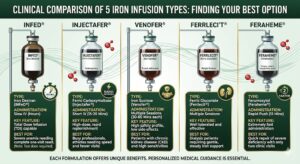
The choice of iron infusion type is not a simple menu selection; it requires clinical precision. It depends on various intersecting factors, including the patient’s underlying medical condition, the severity of the iron deficiency, previous bodily responses to iron therapy, and the inherent risk of allergic reactions. Healthcare providers must evaluate these specific factors—along with comprehensive lab work looking at Ferritin, TIBC, and Transferrin Saturation—when recommending a specific type of iron infusion. Each formulation possesses unique benefits and potential risks, making personalized medical guidance absolutely essential for a safe and effective treatment outcome.
Understanding Potential Side Effects and Safety Protocols
While intravenous iron infusions are generally highly safe when administered in a clinical setting, patients must be aware that some side effects may occur. Common, mild reactions can include temporary headaches, dizziness, mild nausea, muscle cramps, and transient changes in taste (often described as a metallic flavor during the infusion). Severe allergic reactions (anaphylaxis) are exceedingly rare but remain a medical possibility, particularly historically with older iron dextran and ferumoxytol formulations.
To mitigate these risks, it is imperative for patients to thoroughly discuss any known allergies or previous adverse reactions with their healthcare provider before commencing iron infusion therapy. At professional clinics, the use of precision electronic infusion pumps ensures the drug is delivered at the exact mathematical rate your body can handle, drastically reducing the occurrence of side effects like the dreaded “iron headache.”

Revived Personalized Wellness: Supporting Your Health in Houston
At Revived Personalized Wellness, located at 1640 Fountain View Dr, Suite B, we offer various types of advanced iron infusion therapy to help strictly manage iron deficiency and support your overall metabolic health. Finding a trusted Iron infusion Houston clinic means choosing a facility where your safety is the highest priority.
Our experienced medical professionals, directed by Dr. Trevor Peck, provide deeply personalized care to ensure each patient receives the most effective treatment uniquely tailored to their biological needs. Whether you require rapid iron replenishment to get back to your active lifestyle or ongoing, careful iron support for a chronic condition, our clinic is equipped to help.
Contact Us Today: 855-483-7477

Frequently Asked Questions: Understanding IV Iron Options
1. Which type of iron infusion is the “safest”?
While all modern IV iron formulations are FDA-approved and highly safe in a clinical setting, Venofer (Iron Sucrose) is often considered the gentlest option. It is the go-to choice for pregnant women or patients with a history of severe drug allergies. However, “safest” also means using a precision electronic pump to control the flow, which is our standard protocol at Revived Personalized Wellness.
2. Can I simply request Injectafer or Feraheme to save time?
While we understand the desire for a rapid, one-visit solution, the choice of formulation is a strict medical decision. Dr. Trevor Peck will review your comprehensive iron panel—including Ferritin, Total Iron Binding Capacity (TIBC), and Phosphorus levels—to determine if your body can safely handle a high-dose infusion like Injectafer without oxidative stress.
3. How long will I be at the clinic for my infusion?
The duration depends entirely on the drug prescribed. If you receive a rapid-push formulation like Feraheme or Injectafer, the infusion itself takes only 15 to 20 minutes. If your protocol requires Venofer, expect to relax in our luxury chairs for 30 to 60 minutes. For Total Dose Infusions using INFeD, you should plan to be with us for 3 to 4 hours.
4. Why did I get a headache after a previous iron infusion at another clinic?
Post-infusion headaches (sometimes called the “iron flu”) are often caused by the infusion running too fast or the patient being dehydrated prior to the session. The specific carbohydrate shell of the iron drug can also play a role. We use slow-titration protocols and pre-infusion hydration to nearly eliminate this risk. (Read our complete guide on preventing iron infusion headaches for more details.)
5. Are high-dose iron infusions like Monoferric covered by insurance?
Insurance coverage varies wildly depending on your provider, your specific diagnosis (e.g., severe Iron Deficiency Anemia vs. general fatigue), and whether you have failed oral iron therapy first. At our Houston clinic, we accept HSA/FSA payments and can provide a detailed “Superbill” for you to submit to your insurance for out-of-network reimbursement.